
Flamstead Village School
FAQs
Phonics - Frequently Asked Questions
What is a phoneme?
A phoneme is the sound we hear in a word. For example, the word cat has three phonemes: c-a-t.
What is a grapheme?
A grapheme is a letter or group of letters we use to represent a sound when we write it. For example, the sound /sh/ can be represented by the letters sh.
What is a digraph?
A digraph is two letters that work together to represent one sound, such as sh in shop, ch in chip or ai in rain.
What is a trigraph?
A trigraph is three letters that work together to represent one sound, such as igh in night or air in chair.
What does blending and segmenting mean?
Blending is putting sounds together to read a word - for example, c-a-t → cat.
Segmenting is doing the opposite: hearing a word and breaking it into its individual sounds to help with spelling - cat → c-a-t.
Who are the characters?
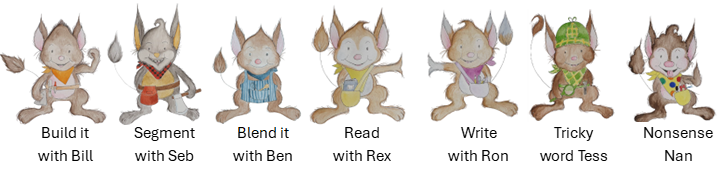
Throughout the programme, pupils meet different Supersonic Phonic Friends who help them remember the skills and strategies they need for reading and spelling.
For example, Blend it with Ben helps pupils blend sounds together to read words, while Segment with Seb helps pupils break words into sounds when spelling.
You may hear your child talking about these characters and using their phrases at home!
When is phonics taught?
Phonics is taught daily, beginning with Firm Foundations in Nursery and progressing through the Basics and Higher Levels as pupils move through Reception and Key Stage 1.
Pupils are also encouraged to apply their phonics throughout the school day when reading and writing, rather than seeing phonics as something that only happens during a phonics lesson.
What books will my child bring home?
The books pupils bring home reflect where they are in their reading journey.
Pupils who are still developing their early listening, sound awareness and blending skills will have books to share and enjoy with an adult.
Once pupils are ready, they will bring home decodable phonics books matched to the phonics they have been taught.
Pupils will also have opportunities to enjoy a wider range of books for pleasure.
Why might my child's reading book seem easy?
This is intentional. A home reading book is an opportunity for pupils to practise and consolidate what they have already been taught, rather than encounter lots of new phonics independently.
Being able to read a book successfully helps pupils develop accuracy, fluency, expression, comprehension and, importantly, confidence.
What are 'tricky words'?
Some commonly used words contain a part that pupils cannot read using phonics. These are introduced as tricky words and taught systematically alongside the pupil's developing phonics knowledge. For example, 'I' 'is' 'the' 'was'.
What can I do at home to support my child?
The most important thing you can do is read, talk and enjoy language together.
Read stories to your child regularly - including books that are more challenging than those they can currently read independently. Talk about characters and events, make predictions and discuss interesting words.
Use a rich and varied vocabulary when talking to your child. There is no need to simplify or avoid 'big' words. Hearing unfamiliar vocabulary in meaningful conversations helps pupils build their understanding of language.
What if my child is finding phonics difficult?
Pupils learn at different rates, and some will need more repetition and practice than others. We regularly assess pupil's phonics knowledge so that we can identify gaps and provide additional practice or support where needed.
If you have concerns about your child's reading or phonics development, please speak to their class teacher.
What is the Year 1 Phonics Screening Check?
Towards the end of Year 1, pupils complete the statutory Phonics Screening Check. Pupils read a selection of real words and unfamiliar 'alien' words so that they can demonstrate their ability to recognise sounds and blend them together.
Pupils are familiar with this type of activity through their normal phonics teaching, and we aim for the check to feel like a familiar phonics activity rather than something to worry about.